What to wear to a Seville flamenco night, and the etiquette nobody explains
Nobody will turn you away for wearing shorts. The things that actually matter in these rooms are quieter than a dress code: your phone, your hands, and what time you walk in.
 By Carmen Ruiz, Seville flamenco show specialist & cultural experience guide
Short answer
There is no formal dress code for flamenco in Seville and none of the sixteen bookable shows publishes one. Smart casual works everywhere, from a $24 room to a $128 rooftop dinner. What matters more is arriving early enough for a good seat, keeping your phone silent, and not clapping along.
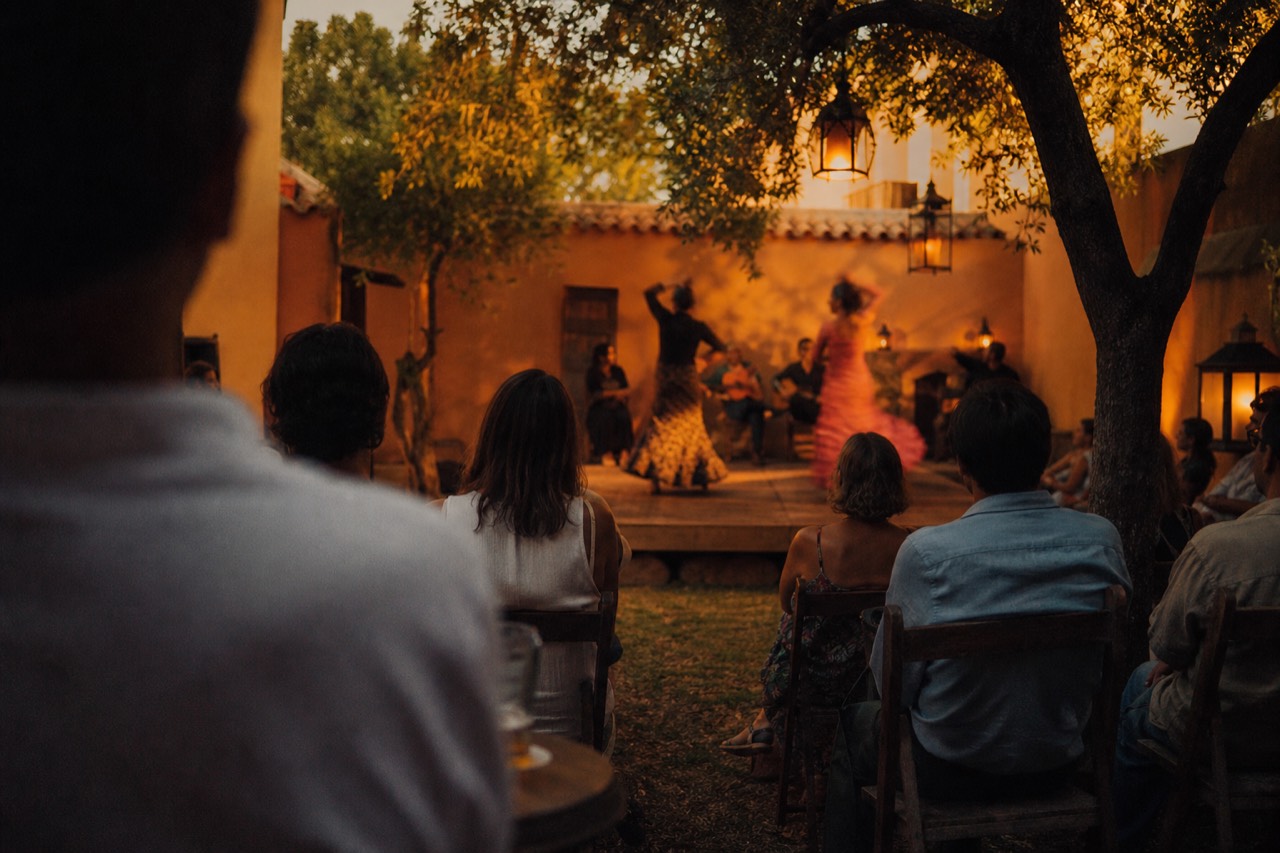
A woman in a sundress and a man in a linen shirt, sitting three rows from a dancer who is about to spend an hour in a bata de cola with a train the length of a dining table. That is the standard picture in a Seville tablao in June, and it tells you most of what you need to know. The performers dress for the tradition. The audience dresses for a warm evening out.
Where visitors actually go wrong is not clothing. It is clapping along in a room where two professional palmeros are holding a twelve-beat cycle, taking a photograph during an hour where photography is forbidden, arriving as the lights go down in a venue with seats assigned by its box office, or bringing a five-year-old to a show whose listing says under-sixes are not recommended. This guide covers the clothes quickly, then spends its time on the things that change your evening.
Prices and review counts in the comparisons are snapshots, not live quotes. Compare the same travel date, currency and ticket tier before paying.
What is the dress code for flamenco?
There is no formal dress code. None of the sixteen bookable shows in Seville publishes one, and no venue on this site turns people away for clothing. Smart casual is right everywhere: a shirt or blouse, trousers or a dress, closed shoes or good sandals. The only genuine constraints are heat, courtyard stone and a long walk home.
That answer holds across a price range from $24 to $128, which is worth stating clearly because expensive listings often imply a standard they do not enforce. A rooftop dinner with a multi-course menu attracts people who dress up, and nobody in a linen shirt looks out of place. A $24 room in Santa Cruz seats people who walked in from a day of sightseeing.
Two soft conventions do exist, and both come from the setting rather than a rule. Andalusians dress well for an evening out, so smart casual reads as normal rather than formal. And several venues are historic buildings with stone floors and open courtyards, which makes heels a practical mistake even when they are an aesthetic success.
The performers are the exception to all of this. Flamenco costume is part of the art form, and the bata de cola, the long-trained dress, is a working instrument rather than a decoration. Watching a dancer control the train through a turn is one of the reliably astonishing moments of a good hour. Nothing about that expects the audience to match it.
| Venue type | What most people wear | What to avoid | Why |
|---|---|---|---|
| Classic tablao ($24 to $44) | Shirt or blouse, trousers, dress, flat shoes | Beachwear, heels on stone | Historic buildings, courtyard floors |
| Theater or museum stage ($29 to $47) | Smart casual, same as a cinema | Nothing in particular | Indoor seating, controlled climate |
| Dinner show ($42 to $128) | Smart casual to dressy | Shorts if you want to feel comfortable | Restaurant setting, longer evening |
| Free bar night | Whatever you were already wearing | Anything you mind spilling on | Standing room, crowded, no seats reserved |
What should you wear to a tablao specifically?
In a tablao, choose for a small warm room rather than for a night out. Layers work better than a jacket, because packed courtyards get hot fast and stone rooms cool down after dark. Flat shoes beat heels on old floors, and something you can sit still in for sixty minutes matters more than anything else.
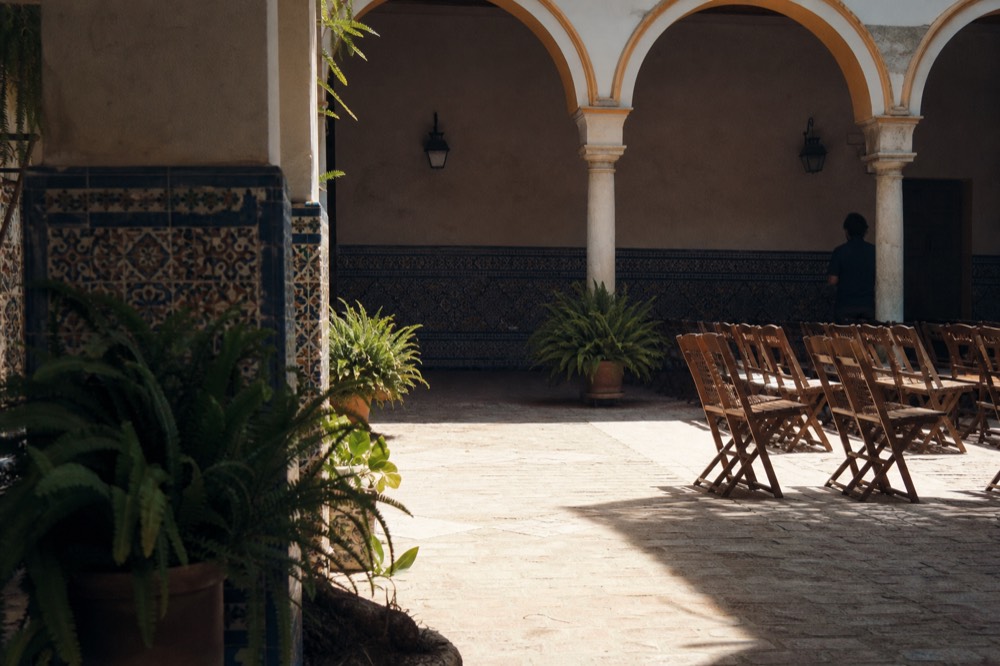
Room scale drives this. Casa de la Guitarra runs a genuinely tight room in Santa Cruz, close enough that a bulky bag becomes a problem for the person beside you. La Casa del Flamenco stages its hour in a 15th-century courtyard with natural acoustics. Casa de la Memoria uses a 15th-century palace off Calle Cuna with seats assigned by its box office. In rooms this size, comfort is a courtesy as much as a preference.
Bags deserve a sentence of their own. There is rarely a cloakroom, chairs are close together, and a rustling tote at your feet is audible in a room without microphones. Take the smallest bag that works. Anyone who has sat through a soleá next to someone hunting for a water bottle understands why this is on the list.
The one clothing choice that reliably improves the hour is footwear. Several of these venues involve cobbles, courtyards, and a walk that starts or ends on the far side of the river. Tablao El Arenal notes twenty-two steps down to its bathrooms with no elevator, which is an access fact rather than a fashion one, and exactly the sort of detail worth checking before booking. The full room-by-room picture sits in the guide to what a tablao is and how the four rooms differ.
Does the season change what you should wear?
Substantially. Seville's July and August normals put average daily highs at 36.0°C and 35.5°C, and 2025 delivered more than thirty days above 40°C. January averages 10.9°C with highs near 16.0°C and lows around 5.7°C. Open courtyards are wonderful in May and punishing in August.
In high summer, the room type matters more than the outfit. Choose the late slot, at 21:00 or 22:30, when the city has cooled and the streets fill again. Choose an indoor stage or an underground room over an open courtyard if you feel the heat. Flamenco Dreams plays in a 12th-century Almohad vault beneath the Dance Museum, with two rows of seats and a drink included, and stone below ground stays cool when the street does not, so it is worth checking availability for a hot week well ahead, since two rows is a very small room.
In winter, invert everything. January evenings are mild by northern European standards and cold by Andalusian ones, courtyards feel it, and an indoor theater is a comfortable choice. Reviewers of the Triana theater regularly single out its air conditioning, which tells you how much venue climate registers with visitors in this city. The best evening months are May, June, September and October, when a courtyard at 20:30 is close to perfect.
Climate normals for Seville airport come from Spain's national meteorological agency, and they are the sensible planning reference rather than a long-range forecast. One practical note that catches people out: the walk to the venue is often the hottest part of the evening in summer, since most rooms are cooled or shaded and the street at 19:00 in August is not.
| Season | Evening conditions | What to wear | Which room suits |
|---|---|---|---|
| March to April | Mild, showers possible | Layers, a light jacket | Indoor rooms during Semana Santa crowds |
| May to June | The best of the year | Light clothes, flat shoes | Open courtyards at their best |
| July to August | Highs of 36.0°C and 35.5°C, 30-plus days above 40°C in 2025 | Linen, sandals, water | Indoor stages, the underground vault, late slots |
| September | Warm and easing | Light layers | Anything, and the Bienal month in 2026 |
| October | Mild, comfortable | Light jacket after dark | Courtyards again |
| November to February | Cool evenings, January highs near 16.0°C | Jacket, closed shoes | Indoor and heated rooms |
Do Semana Santa and Feria change the rules?
They change the city, not the venue policy. Semana Santa runs 29 March to 5 April in 2026 and Feria de Abril follows from 21 to 26 April. Processions and crowds make walking times unpredictable, so pad your arrival. Visitors are not expected to wear traditional dress to either, or to a show.
During Semana Santa the centre becomes difficult to cross at short notice, because processions close streets on their own timetable. A fifteen-minute walk to a Santa Cruz venue can become forty. The fix is simple: leave early, check the route, and pick a venue on your side of any procession rather than gambling on a crossing.
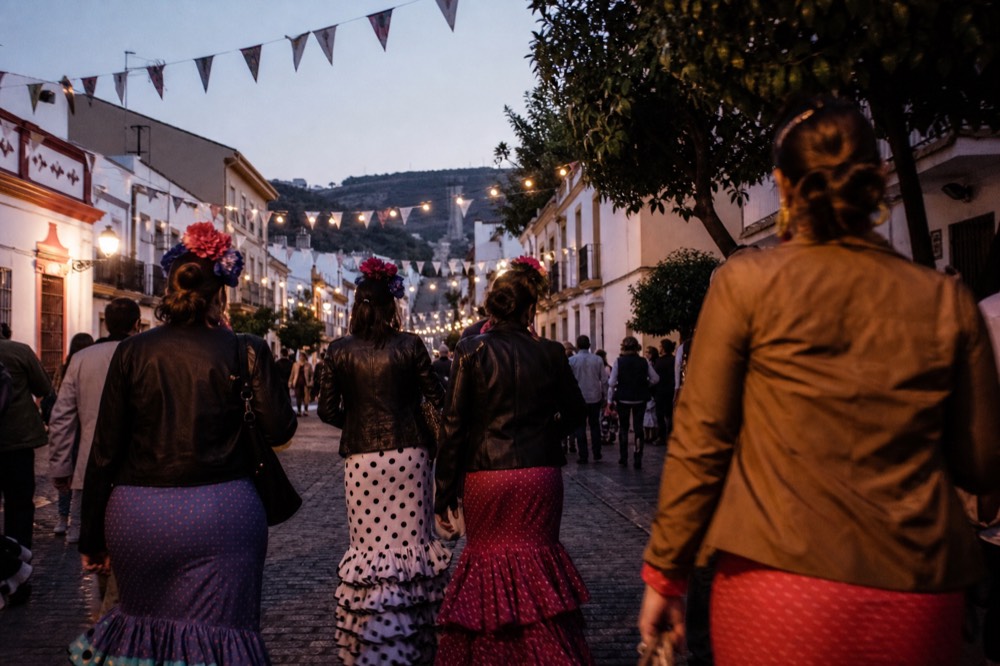
Feria is a different problem. It is Seville's biggest week, accommodation is at its tightest, and locals dress for the fairground in traje de flamenca and traje corto. Those are costumes for the feria, not for a tablao, and no venue expects a visitor to wear either. Shows continue through both weeks, and booking earlier than usual is the only real adjustment.
The XXIV Bienal de Flamenco takes place in Seville in September 2026, with dates 9 September to 3 October. Regular rooms run as normal during festival periods, and the festival detail sits in the note on the Bienal de Flamenco in September 2026. Whichever week you land in, the room policies described further down this page do not change.
When do you clap at a flamenco show, and when do you stay quiet?
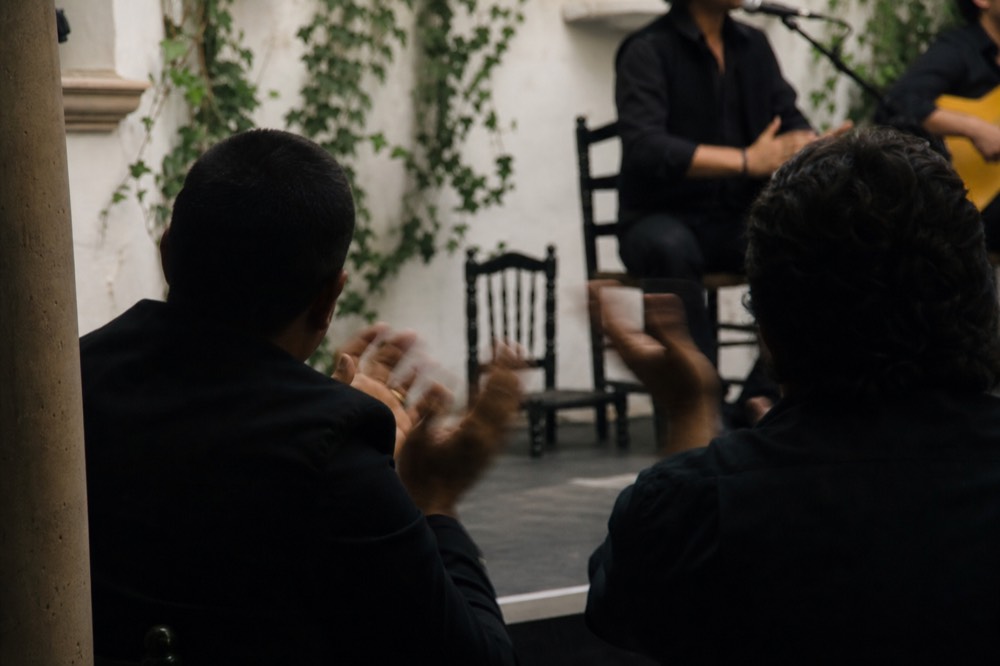
Do not clap along. Professional palmeros hold the compás, the rhythmic cycle that runs on twelve beats in many forms, and a mistimed clap from the audience disrupts dancers and musicians alike. Applaud at the end of a number, and let the shouts of encouragement come from people who know where the accents fall.
This is the single most useful thing a visitor can learn before walking in, and it runs against instinct. The music is rhythmic, the room is warm, the palmas sound like an invitation. They are not. Palmas are a played instrument, with hand positions, dynamics and counter-rhythms, performed by specialists sitting on stage for that purpose. Etiquette guidance from professional flamenco venues is consistent on this point and has been for years: restraint from the audience, always.
What you can do is applaud between numbers, generously, and respond at the natural gaps. Flamenco is not a silent art. The exchange between performers and an engaged room is part of how a set builds, which is why the vocabulary in the next section exists at all. The distinction is between joining the rhythm, which is unhelpful, and reacting to the performance, which is welcome.
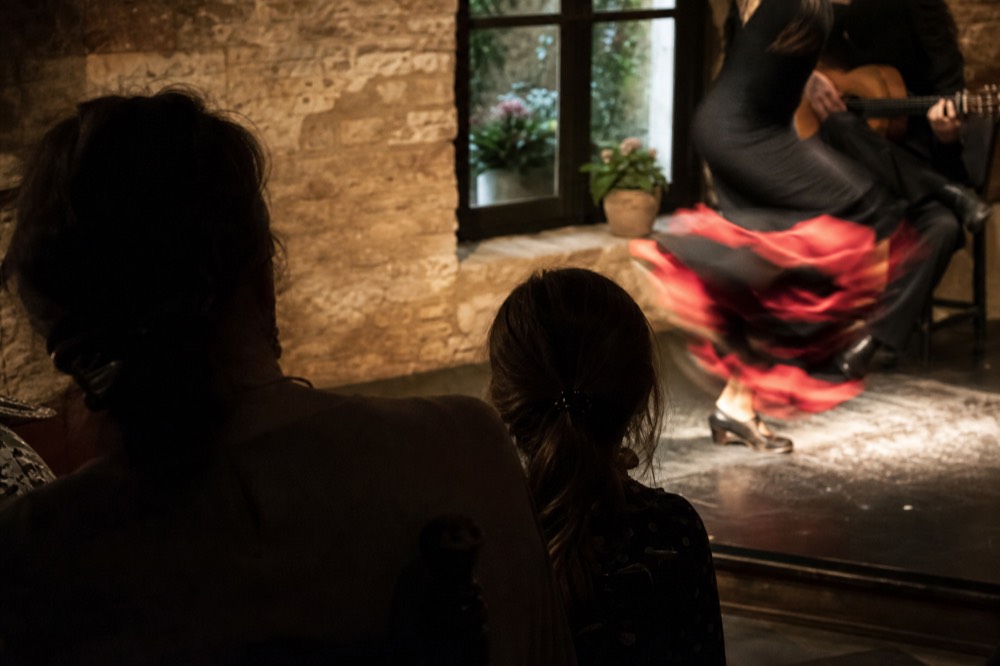
Silence carries further in some rooms than others. Casa de la Memoria and La Casa del Flamenco both state that no microphones are used, which means a whisper, a phone buzzing in a bag or a shifted chair reaches the stage. That intimacy is exactly what makes an unamplified hour worth booking, and it is why both rooms say the show is not recommended for children under six. If the acoustic version appeals, check which nights still have seats, so you can fit the performance around dinner.
| Moment in the hour | What to do | Why |
|---|---|---|
| During a number | Sit still, hands quiet | Palmeros are holding the compás on stage |
| Between numbers | Applaud, loudly | This is where the room answers back |
| During a deep cante passage | Silence, no whispering | Unamplified rooms carry every sound to the stage |
| When regulars shout | Join in the gap if you feel it | Jaleo lands between phrases, never over a lyric |
| At the end of the set | Full applause, stay for the bows | The cuadro usually closes together |
| If you arrive late | Wait for the staff to seat you | Walking in during a number crosses the sightline |
What do the shouts mean, and can you join in?
Jaleo is the vocabulary of encouragement thrown at performers mid-number. Olé is the famous one. Agua, literally water, is shouted to cool an intense passage. Arsa, eso es and vamos all push a performer onward. Audiences do use them, sparingly and at the right moment, and there is no penalty for staying quiet.
Timing is everything and it cannot be learned from a list. The shouts land in the gaps, at the end of a phrase, after a burst of footwork, when a singer has just done something difficult. If you shout over a lyric, you have made yourself part of the show in the wrong way. The safe approach for a first visit is to listen for where the regulars place theirs and follow, or to say nothing at all and applaud hard at the end.
Olé has a debated origin. One longstanding theory links it to the Arabic wa-Allah, used in poetic recitation during Al-Andalus, and scholars note the theory is not universally accepted, with alternative Greek, Hebrew and Spanish derivations proposed. That uncertainty is a fair emblem of flamenco itself, an art built from Romani, Andalusian, Arab-Andalusian and Sephardic threads that resists a single clean origin story.
Learning four words changes the hour more than any clothing decision. It converts an unfamiliar performance into something you can read: you start to notice that the shouts cluster around specific moments, that a singer's hardest line draws the loudest response, and that the room is having a conversation with the stage. That is the difference between watching flamenco and attending it.
| Shout | What it means | When it lands |
|---|---|---|
| Olé | The general cry of approval, origin debated | After a phrase, a turn, a resolved line |
| Agua | Literally water, to cool an intense passage | Mid-number, when the heat is rising |
| Arsa | A push, roughly go on | During footwork, at the build |
| Eso es | That is it, that is the thing | When a performer nails a difficult moment |
| Vamos | Let us go, an urging | Into a fast section, often bulerías |
Can you take photos or use your phone?
It depends on the room, and the rules are specific rather than general. Teatro Flamenco Triana enforces a strict no-photos hour for the whole performance. Tablao Flamenco Andalusí finishes with a photocall alongside the artists. Most other venues state their policy at the door, and every unamplified room expects phones fully silenced.
Treat the no-photos rule as the default and you will never be the problem. In an hour-long set with no interval, a lit screen in a dark room is visible to every person behind you and to the performers, who are working a few metres away with the house lights down. The rooms that forbid photography are not being precious about it, they are protecting the only thing they sell.
Where photography is welcome, it is usually organised rather than incidental. The Andalusí room in the Arenal opens with a short filmed introduction to the palos and closes with a photocall beside the artists, which is a far better souvenir than a dark shaky video from row four. That structure also makes it the easiest room for a first-timer, since you arrive knowing what a soleá is and leave with a picture.
Phones matter beyond photography. Two centre rooms state that no microphones are used at all, and in a room like that a vibrating phone in a bag is audible on stage. Silence it properly, not just to vibrate. If you need a photograph of the venue, take it before the show starts, when the stage is lit and empty and nobody minds.
| Venue | Photo policy | Phone note |
|---|---|---|
| Teatro Flamenco Triana | Strict no photos for the full hour | Silence completely, no exceptions |
| Tablao Flamenco Andalusí | Photocall with the artists after the show | Filmed introduction plays first |
| Casa de la Memoria | Policy stated at the venue | Unamplified room, silence is audible |
| La Casa del Flamenco | Policy stated at the venue | Natural acoustics, no microphones |
| Theater and dinner venues | Policy stated at the venue | Screens are visible to everyone behind you |
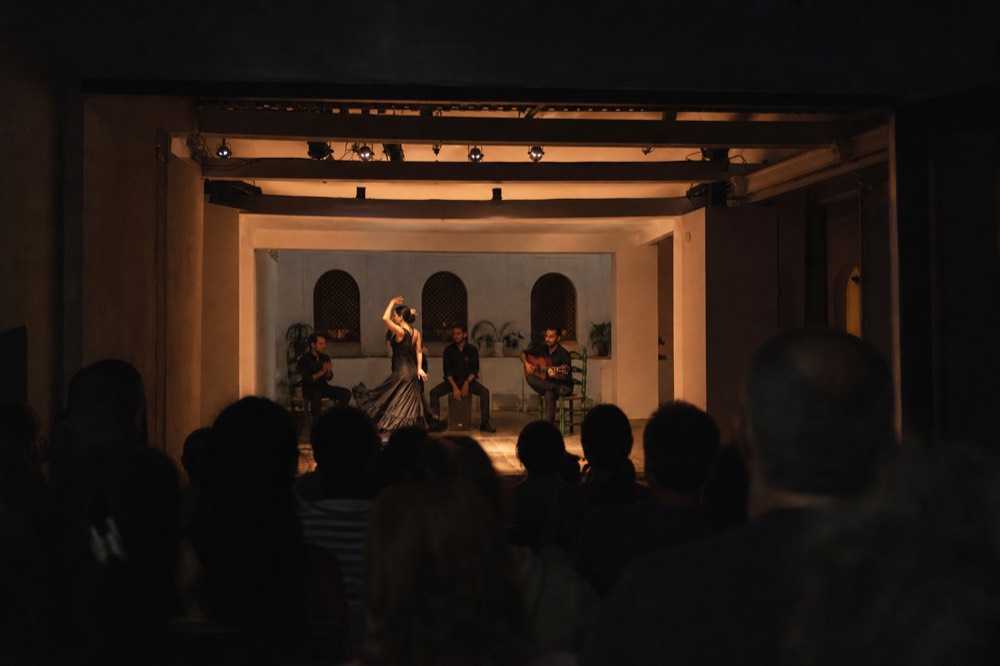
Can you bring children, and to which rooms?
Five of the sixteen listings state an age rule. Baraka sets the lowest floor at four years. Casa de la Memoria and La Casa del Flamenco both say the show is not recommended under six. Teatro Flamenco Triana admits no children under six. The Almohad vault show sets its floor at ten. The remaining eleven state no age limit.
The pattern is not arbitrary. The rooms that discourage young children are the quiet ones, where an hour of unamplified cante gives a restless child nothing to look at and no cover for noise. The rooms with no stated limit tend to be larger, amplified, or structured with something visual happening throughout. That is a better guide than any age number.
For families, the structured rooms work best. The Andalusí show opens with a filmed introduction so a child arrives knowing what is coming, and finishes with a photocall. Teatro Flamenco Sevilla runs several curtains a night, which means an early slot exists, and states no age floor. Across the river, Baraka admits children from four, includes a drink at $27, and runs a compact one-hour quartet format, so it is worth seeing what is free on your dates if you want the earliest possible start with a child in the group.
One more piece of advice that has nothing to do with policy. Take the earliest curtain you can get. Show times cluster between 6:00 pm and 8:30 pm, Spanish dinner does not begin until 9:00 pm, and a child who watches at 18:00 and eats at 20:30 has had a good night. A child at a 22:30 set has not, whatever the listing permits.
| Venue | Stated age rule | Format note |
|---|---|---|
| Baraka Sala Flamenca | No under-4s | One hour, four artists, drink included |
| Casa de la Memoria | Not recommended under 6 | Unamplified, box-office-assigned seats |
| La Casa del Flamenco | Not recommended under 6 | Unamplified courtyard, doors 20 min early |
| Teatro Flamenco Triana | No under-6s | Strict no-photos hour |
| Flamenco Dreams | No under-10s | Two rows of seats in an Almohad vault |
| The other eleven listings | None stated | Includes the theater stages and dinner venues |
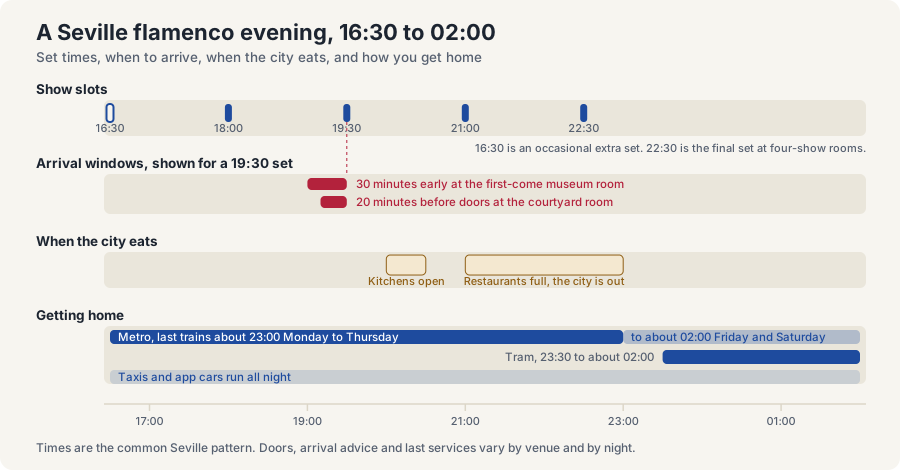
How early should you arrive, and what time will you eat?
Arrive twenty to thirty minutes early at any room with unnumbered or first-come seating, which includes most of the small ones. La Casa del Flamenco opens its doors twenty minutes before the show. Puro Flamenco asks for thirty. Dinner afterwards starts at the Spanish hour, between 9:00 and 11:00 pm.
Arrival time decides your sightline in a way that no ticket tier does. Casa de la Memoria assigns seats at the box office; arrive at least twenty minutes early. Puro Flamenco seats first-come in the museum's 18th-century courtyard. In rooms of forty to a hundred people, the difference between the second row and the back is fifteen minutes of your evening, spent standing in a Seville street that is pleasant to stand in.
La Carbonería Is Temporarily Closed. La Carbonería announced a temporary closure for technical reasons on 3 June 2026, until further notice. Its own site has not posted a reopening announcement. Descriptions of its free-entry format below refer to how it operated before closure; do not plan an evening there without confirming that it has reopened. Read the venue’s closure notice.
Some venues give you a reason to come even earlier. El Palacio Andaluz includes free entry to its Flamenco Dress Museum thirty minutes before the show. Puro Flamenco can be combined with museum entry, though the museum closes around 6:00 pm, so that has to be an afternoon plan rather than a pre-show one. At the free end, La Carbonería fills early enough that regulars advise arriving before roughly 7:00 to 7:20 pm for a seat.
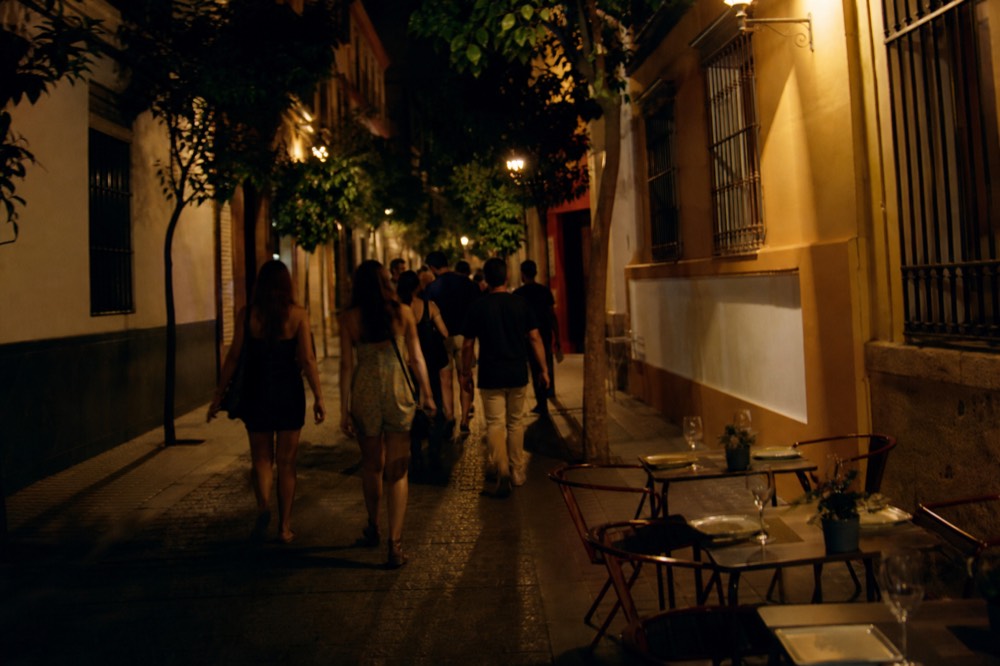
The back end of the evening is set by transport and kitchens. Restaurants open around 8:00 to 8:30 pm and locals rarely sit down before 9:00. The metro runs to about 11:00 pm Monday to Thursday and to around 2:00 am on Friday and Saturday, the tram runs to roughly 11:30 pm on quiet nights and to between 1:30 and 2:00 am on busy ones, and taxis and app cars run all night. Official timetables are published with the city's metropolitan transport information.
| Time | What to do | Why |
|---|---|---|
| 17:30 to 18:00 | Arrive for an early curtain | Best slot if you want a full dinner afterwards |
| 18:00 to 18:30 | First sets of the evening begin | Coolest choice in winter, hottest in August |
| 19:00 to 20:00 | Arrive 20 to 30 min before a 19:30 or 20:30 set | Unnumbered seating rewards early arrival |
| 20:00 to 20:30 | Kitchens open | Nobody local is eating yet |
| 21:00 to 23:00 | Dinner proper, or a late set | Restaurants are full, the city is out |
| 22:30 | Final sets at four-show rooms | Metro closes around 23:00 midweek |
| After 23:00 | Tram, taxi or app car home | Weekend metro runs to about 2:00 am |
Which room forgives a beginner's mistakes?
A structured room with something to watch throughout. The Arenal room that opens with a filmed introduction to the palos and closes with a photocall is the gentlest first evening. A theater stage running several curtains a night is the most forgiving on timing. An unamplified courtyard is the most rewarding and the least tolerant of noise.
Match the room to your confidence. If you have never seen flamenco, an hour of cante jondo in a silent palace room is a demanding first encounter, wonderful for some and long for others. A production with lighting, a larger cast and a designed arc carries a newcomer more easily, and the entry prices are identical, so nothing is lost by starting there. The other shortcut is to try the steps yourself earlier in the day, because an hour of beginner footwork makes the stage version legible in a way no amount of reading does, and you can book a session here as a separate booking from the show.
If you go twice, do it the other way round. See the theater version first, then book a small unamplified room for the second night and the difference will teach you what the format is actually for. Both routes are laid out in every show ranked by night type, while the small rooms across the river are gathered under the intimate venues and the big-cast stages under the theater and museum stages.
One last honest note. Nobody in these rooms is watching what you wear. They are watching the stage, and after ten minutes so are you. The etiquette above exists because these are small rooms with living artists in them, not because flamenco is a formal art, and a visitor who silences a phone and applauds in the right places is a welcome guest in any of the sixteen. If you are still deciding between cities, the comparison with Granada's cave zambras sets both traditions side by side.
Frequently asked questions
Is there a dress code for flamenco shows in Seville?
No. None of the sixteen bookable shows publishes a dress code, and no venue turns people away for clothing. Smart casual covers every room from the $24 ticket to the $128 rooftop dinner. Flat shoes are the one practical recommendation, because several venues are historic buildings with stone floors and courtyards.
Should you clap along during a flamenco performance?
No. Professional palmeros hold the compás on stage, and a mistimed clap from the audience disrupts both dancers and musicians. Applaud between numbers instead, as loudly as you like. Shouts of encouragement such as olé are welcome in the gaps, not over a lyric.
Can you take photos during a flamenco performance in Seville?
Depends on the venue. Teatro Flamenco Triana enforces a strict no-photos hour throughout. Tablao Flamenco Andalusí runs a photocall with the artists after the show. Other rooms state their policy at the door. Assume no photography during the performance and silence your phone completely, especially in the two centre rooms that use no microphones.
What should I wear to a flamenco night in Seville in summer?
Light natural fabrics and flat shoes, and take water for the walk. July and August average highs reach 36.0°C and 35.5°C, and 2025 brought more than thirty days above 40°C. Pick a late slot at 21:00 or 22:30, or choose an indoor stage or the underground vault room instead of an open courtyard.
How early should I arrive at a flamenco venue?
Twenty to thirty minutes before the show at any room with unnumbered or first-come seating. La Casa del Flamenco opens its doors twenty minutes ahead, Puro Flamenco asks for thirty because seating is first-come, and Casa de la Memoria does not number its seats at all. At the free bar sets, regulars arrive before about 7:00 to 7:20 pm.
Can children go to a flamenco performance in Seville?
To most of them, yes. Eleven of the sixteen listings state no age limit. Baraka admits children from four, Casa de la Memoria and La Casa del Flamenco both say the show is not recommended under six, Teatro Flamenco Triana admits no under-sixes, and the Almohad vault show sets its floor at ten. Take the earliest curtain and eat afterwards.
Build Your Flamenco Evening
Check Your Date Before Planning Dinner
Compare Options And Refine Your Choice
Hear guitar, song and dance, then look at the historic guitar collection. Show and guitar collection. Food and drinks are not offered.
Four artists perform without microphones in an intimate palace room. Show admission; no food or drink. Seats assigned by the box office; arrive at least 20 minutes early.
Settle into a one-hour Triana performance with a drink included. Ages 4+. Meet at Calle Pureza 107; hotel transport is not included.
Compare Your Actual Evening Costs
Enter two complete quotes in the same currency for the same party. Include the show, food, drinks and transport you would buy. These are your estimates, not provider prices.
No option in this shortlist meets all those choices. Adjust your time, preference or eligibility filters, or reset to the general recommendation.
General recommendation; confirm the ticket option and guest requirements.
Casa De La Guitarra
Hear guitar, song and dance, then look at the historic guitar collection. Check your date before arranging the rest of the evening.
Show and guitar collection. Food and drinks are not offered.
Scheduled departures from Viator. Availability and final price are confirmed on Viator.