Is flamenco worth it?
An honest answer: what a $24 to $44 hour of flamenco in Seville really delivers, who walks out disappointed and why, and when the free option is enough.
 By Carmen Ruiz, Seville flamenco show specialist & cultural experience guide
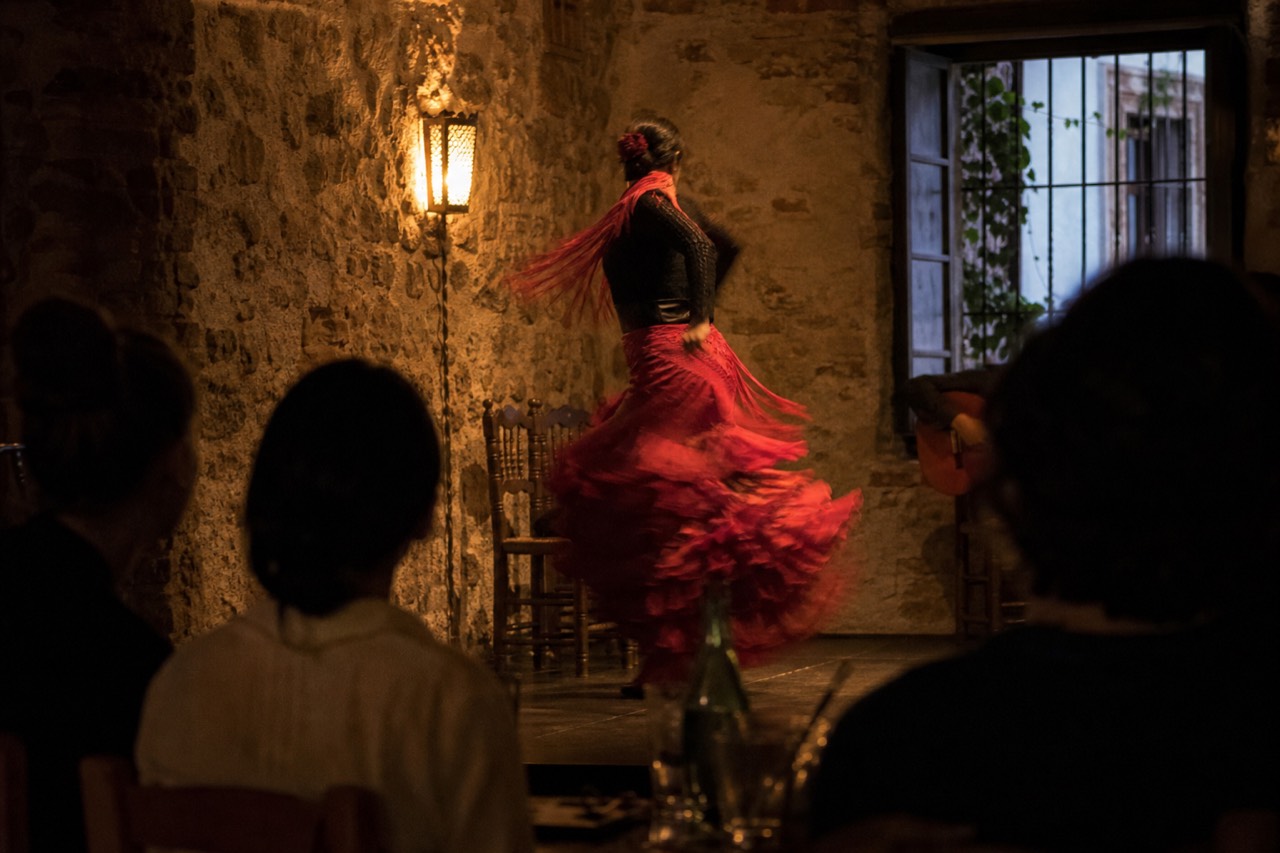
Four artists, no microphones, a room in a 15th-century palace holding maybe sixty people, and an hour that costs $29. That is the version of flamenco most first-time visitors to Seville are actually deciding about, and it is worth being precise about it, because the question "is flamenco worth it" gets answered online by people describing four completely different products.
A programmed tablao hour, a theater production, a bar with a free set, and a dinner package are not variations on a theme. They are separate purchases with separate failure modes. Sort out which one you are buying and the value question mostly answers itself.
Prices and review counts in the comparisons are snapshots, not live quotes. Compare the same travel date, currency and ticket tier before paying.
What does an hour of flamenco in Seville buy for $24 to $44?
Between $24 and $44 you get a professionally programmed show of 60 to 90 minutes with four to eight artists, in a room built for the art rather than for a crowd. At the lower end the ticket is show only; by $35 a drink is usually included; at $44 the format stretches to 75 minutes and eight performers.
| Ticket | Price | Length | On stage | Rating (reviews) |
|---|---|---|---|---|
| Casa de la Guitarra, Santa Cruz | $24 | 1 hour | Classic trio format, guitar collection on the walls | 4.7 (426) |
| Baraka Sala Flamenca, Triana | $27 | 1 hour | Four artists, one drink included | 4.8 (522) |
| Casa de la Memoria, Calle Cuna | $29 | 1 hour | Four artists, no microphones at all | 4.7 (1,088) |
| Teatro Flamenco Sevilla | $29 | 1 hour | Six performers, theater staging | 4.7 (19,771) |
| Tablao Pura Esencia, Calle Betis | $35 | 1 hour | Four artists, drink included, riverside room | 4.9 (769) |
| Tablao Los Gallos, Plaza Santa Cruz | $44 | 75 minutes | Eight artists, running since 1966 | 4.8 (526) |
Set that against almost any other ticketed hour of live performance in a European capital and the pricing is unusual. The people on those stages are working professionals, several of the rooms are 500 years old, and in the unamplified venues you are close enough to hear breath and shoe leather rather than a speaker system.
There is no language barrier either, which surprises people who assume they will miss the point. Flamenco carries meaning through rhythm, dynamics and physical intensity. The singing is in Spanish and the cante jondo lyrics are dense even for Spanish speakers, but nobody in the room is following a plot. An hour is also, deliberately, about the right length: the intensity does not scale to three hours, which is why almost every venue in the city stops at sixty or ninety minutes.
Who leaves a flamenco show disappointed?
Almost always someone who booked the wrong format for what they wanted. The recurring mismatches are simple: expecting intimacy from a large production stage, expecting a party from a concentrated art form, expecting to photograph freely in a room that forbids it, or arriving at showtime somewhere that seats people first come.
| What you were hoping for | The mismatch that ruins it | What to book instead |
|---|---|---|
| Dancers a few feet away | A theater or dinner hall seating hundreds | A small tablao room or one of the Triana venues |
| A big, polished production | A forty-seat room with four artists and no set | A theater stage or a big dinner-show cast |
| A lively night out with friends | A silent, concentrated hour where the audience barely moves | A tapas-and-show evening, or a bar set |
| Photos and video throughout | A venue running a strict no-photos policy | A room without the restriction, checked before booking |
| A front-row view on arrival | Unnumbered seating and a queue that formed 30 minutes ago | Arrive at doors, or pick a venue with assigned seats |
Two specific traps account for a large share of unhappy reviews. The first is seating: several of the best small rooms sell entry rather than a seat, so arriving on time means arriving late in practice. The second is children. Age policies are real and stated on the listings, not suggestions, with under-6 limits at several of the classic rooms and a minimum of 10 at the vault show under the Dance Museum. A restless six-year-old in a silent sixty-minute room is not a good evening for anyone including the six-year-old.
There is a third, quieter disappointment worth naming, because nobody selling tickets mentions it. Some people simply do not respond to the art form. The rhythm is complex, the singing can sound harsh to ears trained on melody, and the emotional register is closer to grief than to entertainment for long stretches. That is a legitimate reaction and not a failure of the show. If it sounds like a real risk for your group, the friendliest on-ramp is a venue that explains the palos before performing them, and it is worth checking the show that opens with a short introduction to the styles rather than starting cold.
Does the UNESCO listing actually mean anything for a visitor?
It means the thing you are watching is a recognized living tradition rather than a tourist invention. Flamenco was inscribed on the UNESCO Representative List of the Intangible Cultural Heritage of Humanity on 16 November 2010, described as a fusion of cante (song), baile (dance) and toque (guitar), and rooted in Andalusia.
Cultural listings can feel like paperwork, but this one has a practical use for a visitor deciding where to spend an evening. It draws the line between flamenco as a performed tradition with named forms and a lineage of teachers, and the generic "Spanish dancing" that any city with tourists can produce. The UNESCO inscription record is public and specific about what was recognized.
The scale of the tradition is larger than one show can suggest. More than fifty traditional palos, or song forms, are commonly counted, though only fifteen to twenty appear regularly in professional venues. A tablao hour typically moves through a handful of them: a slow, heavy soleá, a bright alegrías, a fast and festive bulerías to finish. Knowing that the programme is a tour through forms rather than a single continuous piece changes how the hour reads, and it is the cheapest possible preparation.
Seville's own claim within that tradition is not marketing. The city and the Triana district across the river produced a large share of the families who carried the art form, and the shows on offer here are staffed by people trained inside that lineage rather than imported for the season.
What do travelers single out across 38,810 reviews?
Across the sixteen listings on this site, which carry 38,810 traveler reviews between them, the same handful of things come up: how close the seats are, the absence of microphones in the historic rooms, the performers' visible commitment, and value for money when a museum or a drink is included. The recurring complaint is photo policy.
Read enough of them and the pattern is remarkably stable. Travelers describe rooms only two or three rows deep, artists a few feet away, and an hour of what one reviewer called full-throttle entertainment. Small-room reviews mention hearing the guitar unamplified as the thing they did not expect. Air conditioning appears more often than you would think, which tells you something about a Seville summer: 2025 brought more than thirty days above 40°C in the city, and the Spanish met office's climate normals put the July average high at 36.0°C.
Museum-attached shows draw their own specific praise, and it is nearly always about value rather than the dancing, because one ticket covers two attractions. Travelers who want that combination should check what the museum courtyard show costs with entry included, keeping in mind that its seating is first come and the doors are worth reaching half an hour early.
The friction is narrower and equally consistent. Photo rules are the single most common gripe: policies vary by venue, some enforce them strictly, and travelers who arrive planning to film want clearer rules and a longer window. Read the venue's photo policy before booking if that matters to you, and treat a no-photos hour as a feature of the room rather than an insult.
For anyone weighing which of those rooms is theirs, the ranked pick of the city's shows does the comparison venue by venue, and the full ticket price ladder explains what moves a ticket from $24 to $128.
Is the free option good enough on its own?
La Carbonería Is Temporarily Closed. La Carbonería announced a temporary closure for technical reasons on 3 June 2026, until further notice. Its own site has not posted a reopening announcement. Descriptions of its free-entry format below refer to how it operated before closure; do not plan an evening there without confirming that it has reopened. Read the venue’s closure notice.
For some travelers, yes. La Carbonería charges nothing at the door, runs short sets of roughly 30 minutes across an evening, and asks only that you buy a drink, with some accounts noting cash only. It is a real bar with real flamenco. What it cannot promise is a programmed show, a good sightline, or a specific standard on a given night.
The trade is predictability, and it cuts both ways. Arrive before 7 pm, because seating is first come and the room fills; expect a rustic, noisy space rather than a theater; expect thirty minutes rather than sixty. On a good night it is the most atmospheric flamenco in Seville and it costs the price of a beer. On an ordinary night it is a busy bar with music happening somewhere near the back. The honest verdict on La Carbonería covers the practicalities in full, and the roundup of free flamenco options covers what else in the city costs nothing.
The strongest argument for doing both is that they answer different questions. The free bar tells you whether the art form grabs you. A ticketed hour in a small room tells you what it can do when four professionals have a programmed set, a proper floor and a quiet audience. Doing the bar first and the tablao second is a genuinely good sequence for a three-night trip, and it costs less than one dinner-show ticket.
So, is flamenco worth it in Seville?
Yes, for most visitors, provided the format matches the expectation. At $24 to $44 for a professionally programmed hour in rooms of this quality, the value is unusual by any European standard. It stops being worth it when the room is wrong: a huge production for someone who wanted proximity, or silence and concentration for someone who wanted a night out.
The people who consistently rate these evenings highly did three unremarkable things. They picked a format deliberately rather than booking the first result. They arrived early enough to get a seat that matters in rooms with unnumbered seating. They read the age and photo policies before turning up with a five-year-old and a camera.
The people who do not enjoy it usually paid more, not less. Big packages carry more moving parts, and the lowest-rated listing in this lineup is also the most expensive one. Spending less on the ticket and more attention on the choice is the better trade almost every time.
If a single recommendation helps: for a first flamenco hour, pick a small room in the classic tablao category or one of the Triana venues across the river, book a slot at 6 pm or 7 pm, and arrive when the doors open. That is a $24 to $35 decision that people remember for years, which is a strange thing to be able to say about a Tuesday evening.
Build Your Flamenco Evening
Check Your Date Before Planning Dinner
Compare Options And Refine Your Choice
Four artists perform without microphones in an intimate palace room. Show admission; no food or drink. Seats assigned by the box office; arrive at least 20 minutes early.
Hear guitar, song and dance, then look at the historic guitar collection. Show and guitar collection. Food and drinks are not offered.
Keep the show and an optional tapas or dinner sitting in one venue. Show approximately 60–75 minutes; allow about three hours when adding dinner. Choose the food tier: a base ticket is not a full meal. Bathrooms require stairs.
Compare Your Actual Evening Costs
Enter two complete quotes in the same currency for the same party. Include the show, food, drinks and transport you would buy. These are your estimates, not provider prices.
No option in this shortlist meets all those choices. Adjust your time, preference or eligibility filters, or reset to the general recommendation.
General recommendation; confirm the ticket option and guest requirements.
Casa De La Memoria
Four artists perform without microphones in an intimate palace room. Check your date before arranging the rest of the evening.
Show admission; no food or drink. Seats assigned by the box office; arrive at least 20 minutes early.
Scheduled departures from Viator. Availability and final price are confirmed on Viator.